Firstly, let’s briefly consider what a maths tutor actually does. This isn’t quite as simple as it initially sounds and the obvious answer –maths tutoring (duh!)– doesn’t really tell us much.
In reality, tutors are much like teachers, the distinguishing factor being the size of the class that they teach. Usually, a tutor will teach just one or two students at a time, meaning that they are able to fine-tune their teaching according to their students’ needs.
This has a number of implications. A good tutor is able to explain and break down concepts in terms that the individual student will understand. This means being able grasp where there are gaps in knowledge and how best to approach them for the individual.
Similarly, since maths learning is almost always best approached by doing, a large part of the job of a maths tutor is being able to support an individual student as they work through a maths problem and give feedback. This is a careful balance of giving the student enough space to make their own cognitive leaps while also providing nudges and guidance when needed.
But maths tutors are also usually hired when a student in struggling with some aspect of maths, and so their is often another, more important part of being a maths tutor: Building a student’s maths confidence. This is tantamount to improving performance in standardised maths exams.
As such, we can already see how being a good tutor requires a great deal of subject mastery as well as the ability to be sensitive to a student’s emotional requirements as they approach a subject that often causes significant worry. How much of this can realistically be replaced by AI?
It turns out that AI has proven to be very good at many of the things that are important for a good maths tutor, while there are still other aspects that only a human can really do. Listed are the things that generalised AI’s such as ChatGPT and Gemini can help you out with.
Language models are designed to provide responses that match user input and intent, and so this makes them surprisingly good at explaining concepts in a way that a student will understand. The discursive nature of chatbot interfaces means that students can clarify where their misunderstandings lie, so that provided with enough information, AI tutors can get a pretty good picture of where knowledge gaps lie.
AI maths tutors are fantastic opportunities for students to practice in an environment that is completely free of judgement. Students who might struggle with maths but might shy away from asking for help in front of peers or from their teachers are able to interact with an entity which responds with complete neutrality and infinite patience.
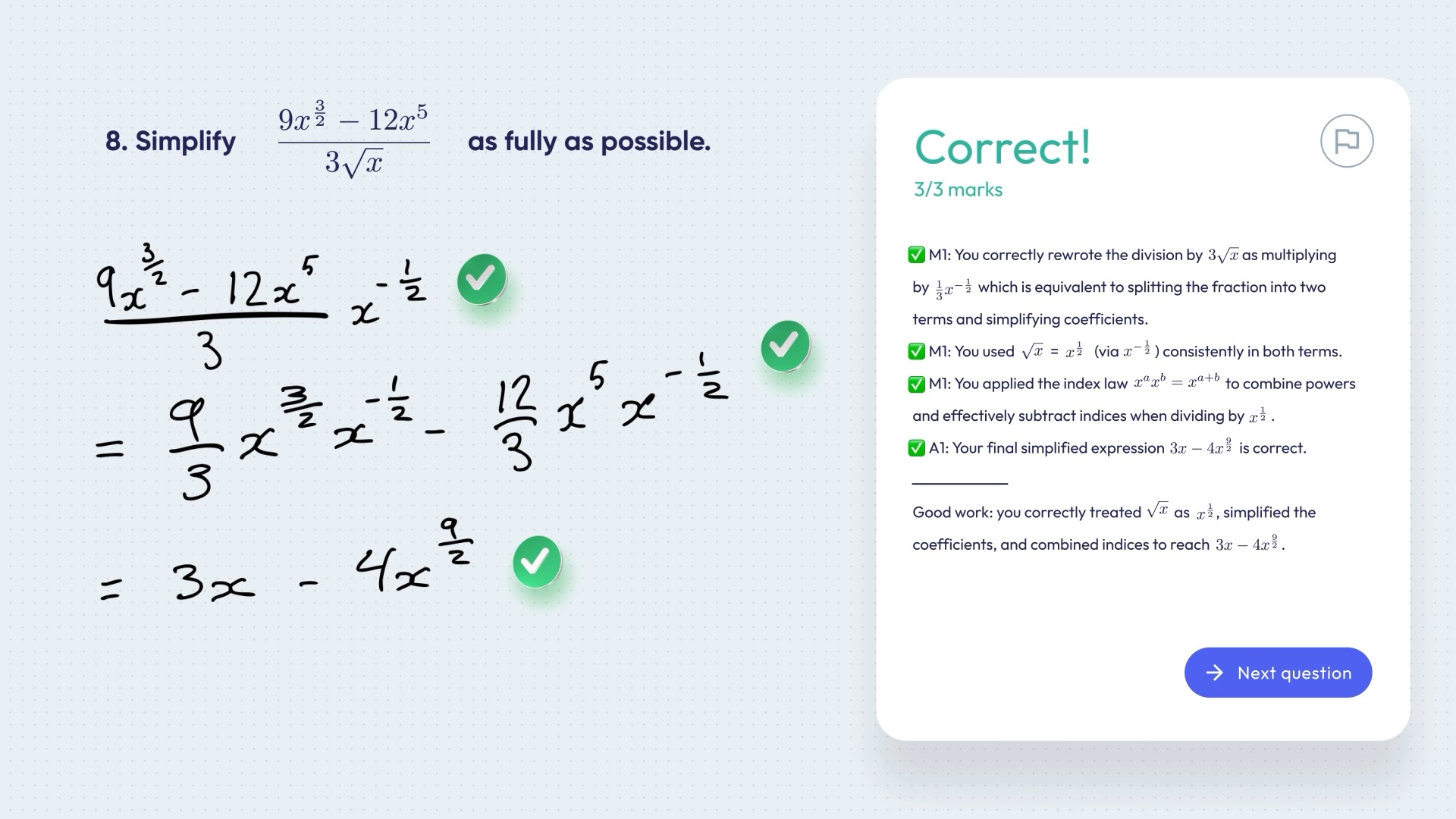
An AI maths tutor is perfect for marking structured exercises. It can provide feedback instantly and is available whenever the student is ready to learn. Models have become very accurate when solving the types of maths questions that students are faced with in high school.
AI is also pretty helpful when it comes to working through problems with students. If students can accurately describe where they are getting stuck with a problem, perhaps with the help of a picture of their working, AI can often accurately determine where the misunderstanding lies and how to best coax the student towards new understanding.
The main problem in this regard is the interface by which the student communicates with the AI. Since maths is handwritten, the process of uploading working for the AI to correct is unwieldy and potentially interrupts the learning flow.
Now that we’ve had a look at the things that AI can do, we’ll address what it can’t. In summary, an AI maths tutor is hindered in a number of ways by the fact that it is not human, and therefore cannot truly understand a student’s feelings.
AI simply cannot yet understand or read human emotions in the way that a human can. This means it cannot change it’s teaching style depending on the mood of the student, bar the student telling it directly. This is very different then a tutor recognising the fact that a student is confused or irritable and therefore taking a different tack.
Part of tutoring is developing a teaching relationship with the student which fosters motivation and further learning. Since AI is not a thinking and feeling entity in the way that a human is, this is impossible. There is no social accountability to an AI, other than that which might be mimicked.
There is a fundamental difference between the relationship between a student and a tutor and a student and an AI. This is the way that they interact with each other. With a maths AI, the interaction is prompt-based. The AI is provided with some sort of information, which then yields a certain output.
With a real tutor, there is a person who becomes responsible for part of a student’s education. They are able to see the individual as a whole and guide their entire learning process.