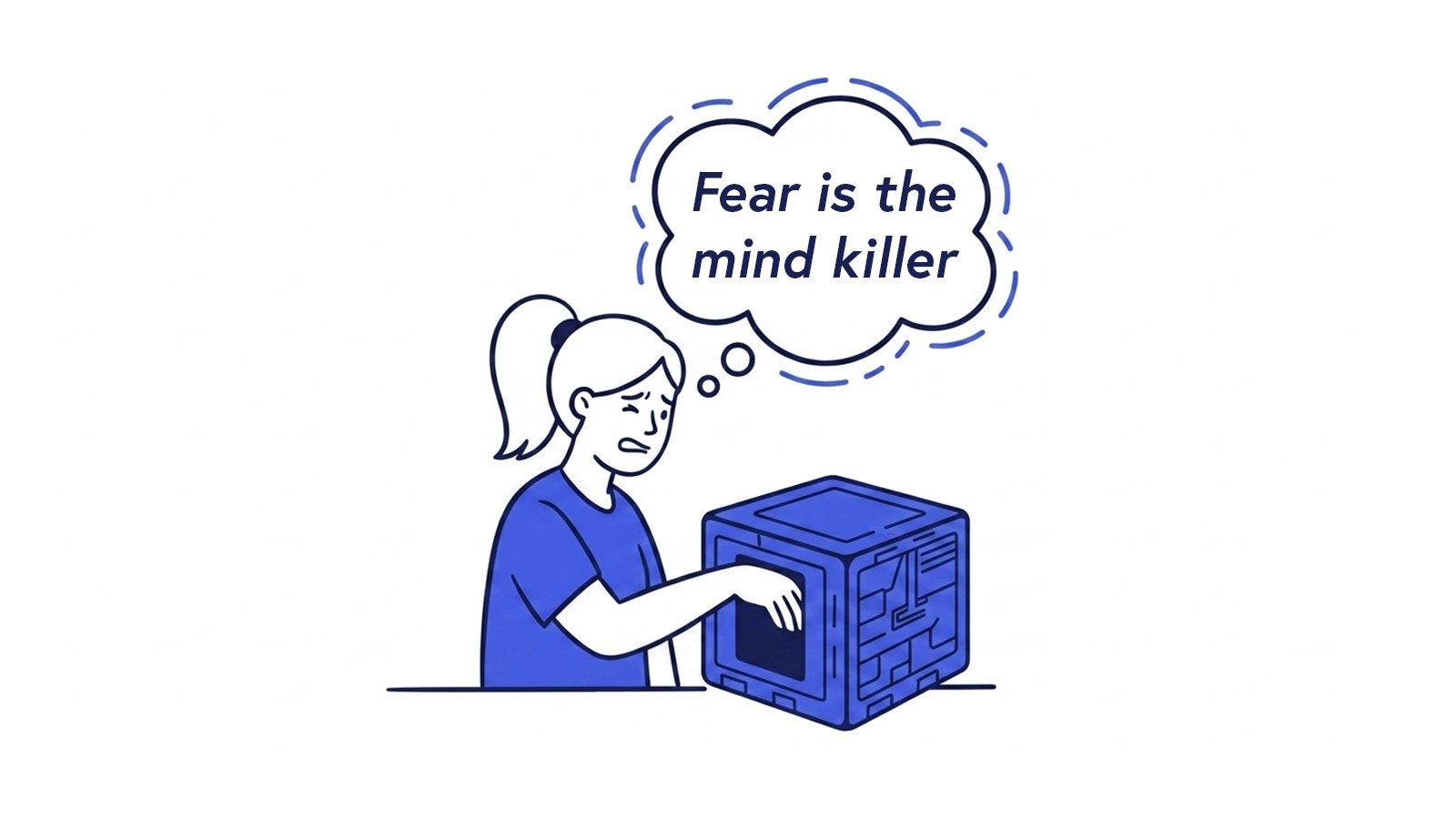
Before continuing, it’s important to have a sense of how anxiety impairs your ability to solve a maths question. In essence, many theories of mind posit that the brain has limited resources which may be diverted in different directions.
In the anxious mind, more resources are diverted to things that are not directly beneficial to learning or solving the mathematical problem at hand. For example, someone in an anxious state is more sensitive to threats (whether they are there not) meaning they are much more easily distracted. Similarly, they are likely to find it harder to hold things in their short-term memory, as more mental resources are directed to other parts of the brain.
Understanding that anxiety makes it harder to complete complex tasks is important, because it allows you to develop strategies to deal with it when you are learning.
Set yourself really small tasks that are easy and low-pressure. Focus on those and then build up from there. Don’t try to tackle a big topic all at once, as this is likely to make you to feel overwhelmed and anxious.
The rationale here is to reduce the difficulty of the task so that you can deal with it even if your abilities feel reduced by anxiety. By building up small ‘wins’, you train your brain to remember that you can do maths.
Aim for regular practice in this way so that you can build momentum and see progress, each time trying a task that is slightly more challenging. But continue to focus on one thing at a time.
It might feel better to just watch videos or re-read material rather than deal with looking at a question. But this often actually increases anxiety because you’re just overloading your brain with content it doesn’t yet understand. You come away feeling more confused and anxious then before.
Much better is to do small, easier questions which make you practice actively. Anxious brains have to be given something that provides the right amount of stimulation, neither too ‘easy’ (re-reading) nor to hard (a complicated multi-step question).
It’s important to know what to do when you do start feeling anxious. First of all, you need to recognise the feeling of anxiety as you experience it. This might be restlessness, increased heart rate, fear, ‘mind blank’ or other physical, cognitive and behavioural symptoms.
When you’ve recognised the feeling, it’s often best to take a step back and try to ‘reset’. Try to work out what works best for you. Things that can help include: slow breathing, consciously relaxing your muscles, going for a walk, taking a break, skipping to another easier question.
It’s super important to ask for help when you need it. It doesn’t indicate that you are any less capable. People get stuck regardless of their maths ability, even people doing very advanced maths.
If you recognise that you are feeling anxious regarding maths, this is often a sign that you should talk to someone about it. Ask your teacher or a tutor (if you have the means) for extra support. They can help you to break down problems into smaller, more manageable chunks, thereby allowing you to move forward.
If you feel that anxiousness is affecting other parts of your life, its vital that you talk to someone about it and try to get support from a mental health professional.
Don’t hold yourself to unattainable standards or constantly strive for ‘perfection’. This is more than likely to make your anxiety surrounding maths worse. By placing this pressure on yourself, any small setback will be far harder to deal with.
Instead, focus on making incremental steps of ‘good enough’. If you manage to complete most of a question, but make a calculation error which carries through, recognise the progress that you have made rather than focusing entirely on the error which lost you one or two marks.
This change in perspective is also about recognising that your grade in your maths exam isn’t the most important thing in your life. Paradoxical as this may sound, if you manage to do this successfully (without going too far the other way), you may just find yourself getting a better grade.