Maths education is crucial for everyone.
Maths at secondary level is not just about memorising formulas and finding x. It develops cognitive skills, supports other subjects, and - whether immediately obvious or not - prepares students for real life scenarios. And while the rise of AI may cause some to think that maths education now matters less, it is actually worth more than ever.
Put simply, maths is foundational for brain development. It trains problem-solving, working memory, pattern recognition and analytical thinking. Proofs follow logical sequences; manipulating algebraic expressions develops symbolic reasoning; geometry trains spatial reasoning; and statistics exercises how you interpret evidence. Those are just some examples of ways in which secondary maths education strengthens transferable skills that are applicable in the wider world. So, yes, students may not use the sine rule itself outside of the classroom. But will they benefit from the problem-solving capacities that practising using the sine rule develops? Absolutely.
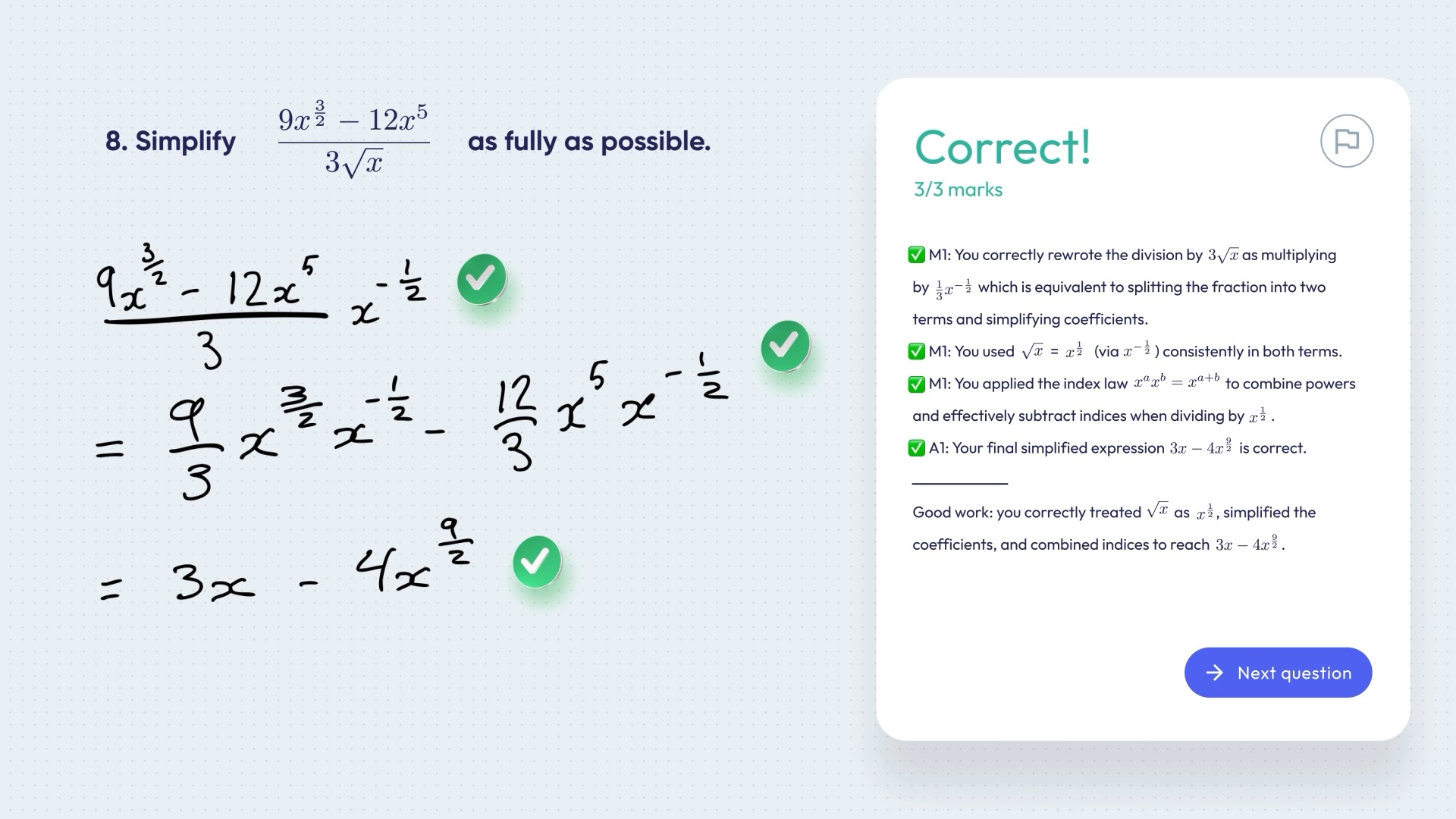
These thinking skills generated from methodical understanding in maths are part of our core ethos.
Maths teaches students how to think critically, structure approaches step-by-step, justify conclusions, and recognise when an argument does not make sense. In fact, the transferable skills that maths strengthens also support other school subjects. For instance, considering a source critically, structuring an essay, justifying a thesis and evaluating a counter-argument are exactly the skills that are used in a subject like History. Though students may not be conscious of it, the skills that they build in maths, they then apply in a different subject down the corridor.
Even more tangible than these skills - mathematical methods are used directly in other subjects. Physics uses algebraic manipulation, vectors and calculus. Biology uses statistics and data analysis. Art and Design uses geometry and proportion. Without maths, many subjects cannot be fully understood. And beyond the school gates, believe it or not, maths is essential in real life situations. Be it in a future career or paying off a mortgage, maths isn’t going away. We live in a data-driven world, and many future careers will incorporate mathematics in one way or another.
From a psychological standpoint, the subject is one of the most beneficial to the brain. Maths involves a high cognitive load; it demands high mental effort from students. While such effort is often a pain point for learners, it strengthens neural pathways more than many other practices. This mindset alone requires mental discipline that toughens students and builds resilience going forward. In turn, such patience and diligence fosters a growth mindset that accelerates student progress across the board.
These benefits have always made maths education important. And in the age of AI, they have not lost importance, but rather become even more essential.
In many ways, AI can make work easier, and there are many reasons why students still need maths skills in spite of this. Firstly, deferral of tasks to AI can ultimately result in over-reliance, dependency and loss of agency. If students cannot find the solutions to problems themselves, without technology, they lose the sense of autonomy that is essential for self-motivation. Secondly, AI is not always correct. It can give wrong answers, misunderstand context, or even fabricate information altogether. Thirdly, forgoing maths education creates a huge obstacle to future innovation. Humans did not stop learning arithmetic when calculators were invented. What maths teaches you is more than just the numbers that plug in and out of equations; it is the logical human thinking behind it. Future advancements need mathematicians, engineers, scientists, programmers — and they need maths.
But most importantly, students need maths not despite AI, but because of AI.
AI does not remove the need to understand maths — it actually makes mathematical understanding more valuable. The underlying logical and analytical thinking that is gained from learning maths inform students how to use AI properly. This conceptual foundation, established by secondary maths education, is what allows AI to be used well. It is what enables students to guide AI, interrogate it, sense-check it, and apply it meaningfully. If students lack this, they won’t correctly grasp how to construct effective prompts, what assumptions are being made with each input, how to interpret the output, or whether the result makes sense. Without mathematical understanding, students cannot use AI with true control, judgement or agency — instead, they only defer to it. In a world where AI is constantly gaining influence, it is crucial to educate young people on the structures, logic and quantitative ideas that underpin the technology. The better students understand mathematical concepts, the better equipped they will be to use AI as a productive tool, rather than a black box they passively depend on.
Read more about the responsible use of AI should look in schools.
Maths is, and will always be, vital. It is the subject with perhaps the most powerful impact on cognitive development. The skills that maths education develops are transferrable across school subjects and, whether students realise or not, are applicable in future real-life situations. And amidst the rise of AI, human autonomy and ability to think critically independently carries more value than ever.