In a 2024 study in Türkiye explored the “crutch effect” of over-reliance on AI tools. Researchers split 1000 teenage maths students into three groups:
In practice tasks, the GPT Base group showed a performance 48% better than the control group, but later, scored 17% worse in closed-book exams. Meanwhile, the GPT Tutor group showed an even larger improvement in practice — 127% better than the control group — yet achieved the same results as the control group in exams.
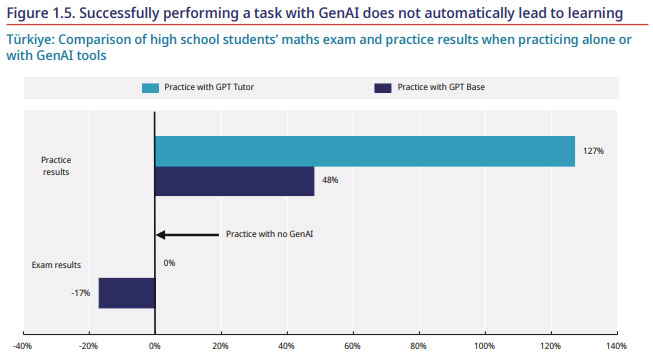
These results suggest that while AI can considerably improve short term performance, even education-oriented interfaces do not always improve long-term learning and retention. The apparent gains can create an illusion of understanding when the underlying cognitive work has not taken place.
Educators must therefore be cautious. That said, these findings should not be discouraging. We are in the very early stages of these developments, and these results highlight the enormous importance, and potential, of good interface design.
The interface through which learning occurs has a major influence on student cognition. Cognitive Load Theory divides mental effort in learning into 3 types of load:
Interface design mainly impacts extraneous load. To optimise learning, the goal is to strike a balance between manageable, easily-absorbable extraneous load and high ‘desirably difficult’ germane load that forces students to think deeply. But, if extraneous load is too low, or the platform does not sufficiently engage students, it lowers the germane load. This reduces the cognitive effort required to truly understand the material, and learning becomes superficial. This is often the case with AI tools in education. They present information in a clear, efficient way; but this clarity can result in students being spoon-fed information too easily, without processing it themselves. As a result, little material that the student is ‘learning’ actually sinks in.
Effective educational AI interfaces must therefore be designed to sustain a high germane load — essentially, engage students. One way to achieve this is attention capture: multi-modal, varied interfaces capture more attention than text-heavy presentation. Even better are highly interactive environments that promote active participation, rather than passive reading. For example, platforms that incorporate handwriting can be particularly powerful, because not only does it demand direct student engagement, but the deliberate, complex motor movements of handwriting encode memory much more effectively than typing. This engagement with the material demands high germane load while maintaining low extraneous load — an ideal balance for learning.
Educators and scientists have been seeking to create the best educational interfaces for centuries. The first manuscripts and libraries date back thousands of years, followed by the likes of the printing press, which made books widely available; the chalkboard in the early 1800s, which revolutionised classroom learning; and the ballpoint pen in the mid-20th century, which dramatically improved access to education and increased global literacy. More recently, these static mediums have evolved alongside early digital advancements, from educational television programmes like Sesame Street, to personal computers, and then the Internet opening doors for word processing and access to digital information. Since then, Learning Management Systems, mobile devices and apps have facilitated more interactive and collaborative learning, both in-person and remote.
Now, AI presents the newest frontier.
But most AI tools were not designed with education in mind. And this shows in their user interface. General-purpose LLMs, such as Claude or ChatGPT, present many flaws when used in education. They are text-heavy, offer minimal personalisation to individual learning style, and operate with no grounding in pedagogy, level, or curriculum. Also, these tools have no direct student-teacher connection, which can diminish teacher oversight and autonomy.
These design shortcomings reduce engagement with the material, encourage passive consumption, distance students from their teachers, and can produce inaccurate or irrelevant explanations.
Well-designed interfaces look different. They combine text with other modalities, like visuals, gestures, or even speech and simulations. For instance, visual tools can help learners grasp complex relationships more quickly than text alone. One study demonstrated that teachers who used an AI-supported mind-mapping tool not only outperformed control groups, but also exhibited a more detailed knowledge construction process. Alternatively, analytical dashboards and visual data representations can help students and teachers to rapidly grasp where they need to target their work. If this information is well-coordinated and is not overwhelming, these alternative forms can enable richer learning interactions and a more engaging, holistic learning experience.
Another essential feature of good educational AI interfaces is direct connection between students and teachers. This visibility is crucial. Transparency between students and teachers should be integrated into the platform interface, so that teachers maintain control over the learning situation. Teachers should be able to see how often students use AI tools, what areas they use them for, as well as how they use them. Otherwise, unmonitored use of AI can lead to the loss of teacher authority, student over-reliance on AI, and sub-optimal learning due to improper balance between extraneous and germane load.
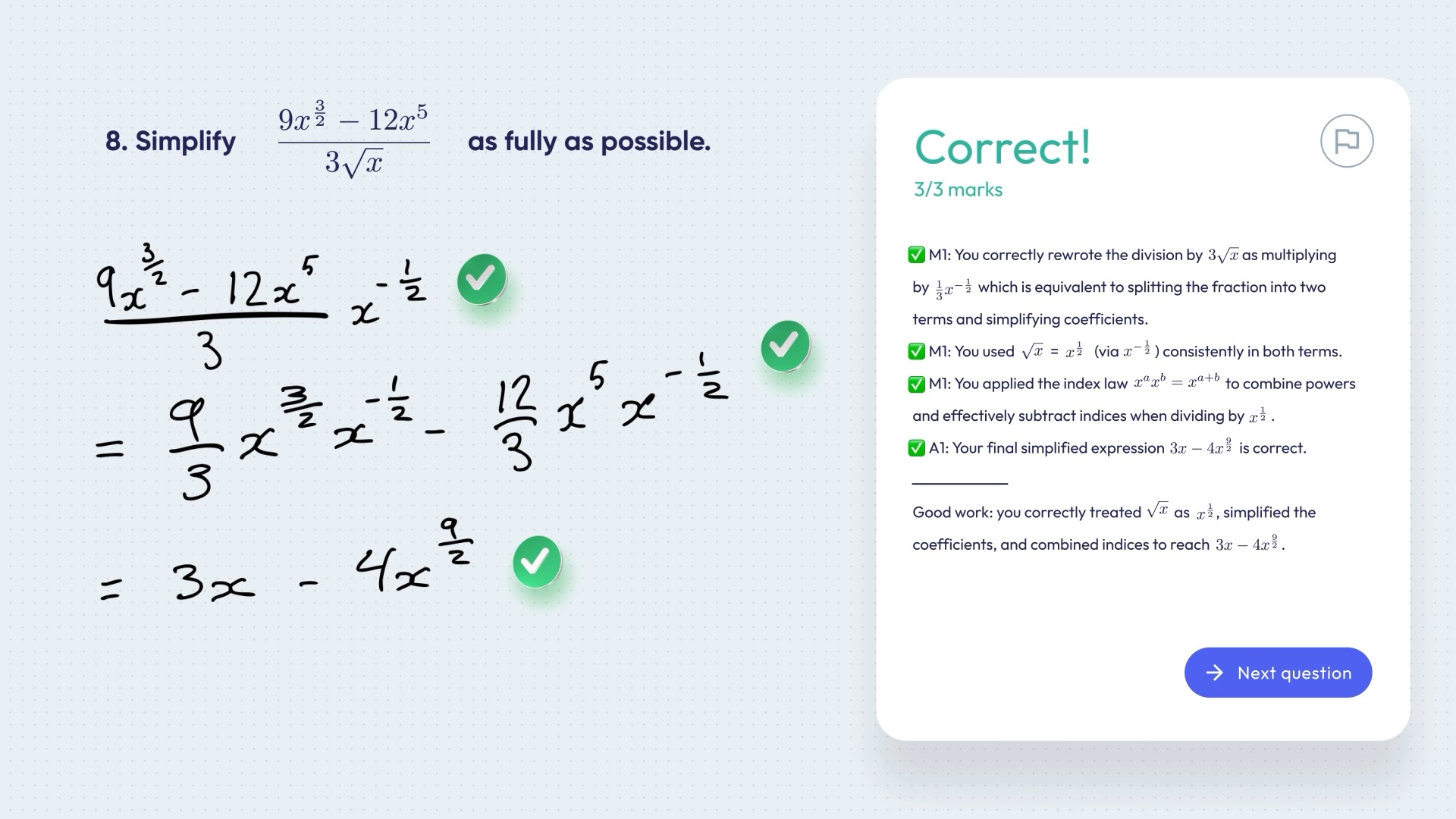
Lastly, different disciplines rely on different modes of expression — AI interfaces should reflect that. Educational interfaces should enable students to communicate in the way that is most natural to the subject. For example, in subjects like English or History, text or speech might be a natural medium. In Maths, however, writing by hand is most intuitive. Students reason through mathematical notation, diagrams, and step-by-step symbolic working. These can be typed out, but doing so is often slower, more awkward, less representative of how students actually think, and can even distract from the real mathematical reasoning. What maths students need is an interface that allows them to write by hand. In the past this has been a chalkboard, paper, or even a whiteboard — now, digital interfaces with handwriting recognition are made possible by AI.
Looking forward, AI opens doors for many further developments. Multi-agent systems could involve not just an AI tutor, but one or more simulated peers. The user could discuss with extra student perspectives, compare methods and improve on their peers’ mistakes. Interfaces may become increasingly multi-modal, combining handwriting, speech, diagrams and simulations into a single learning environment. Another possibility is more advanced human-like traits in AI agents, such as communication through facial expressions or body language, or the ability to listen and speak.
However, deeper research will have to investigate how these tools really affect attention, effort and long-term retention, as well as how they could be integrated without risking sacrificing real-life classroom activity.
AI is not going to stop developing. As learning increasingly takes place through digital platforms, the interface itself becomes part of the pedagogy. The way information is presented, the feedback students receive, and the effort required to reach an answer all shape how knowledge is built. Poorly designed systems can create the illusion of understanding without real learning.
At the same time, AI offers new possibilities for richer, more interactive educational interfaces — from multi-modal explanations to collaborative and adaptive learning environments. But these benefits will only be realised if design is guided by sound pedagogy, curriculum awareness, and clear teacher oversight. Interfaces should not remove effort from learning, but direct it productively. In the age of AI, the interface is no longer just a tool; it is a new version of the classroom.