
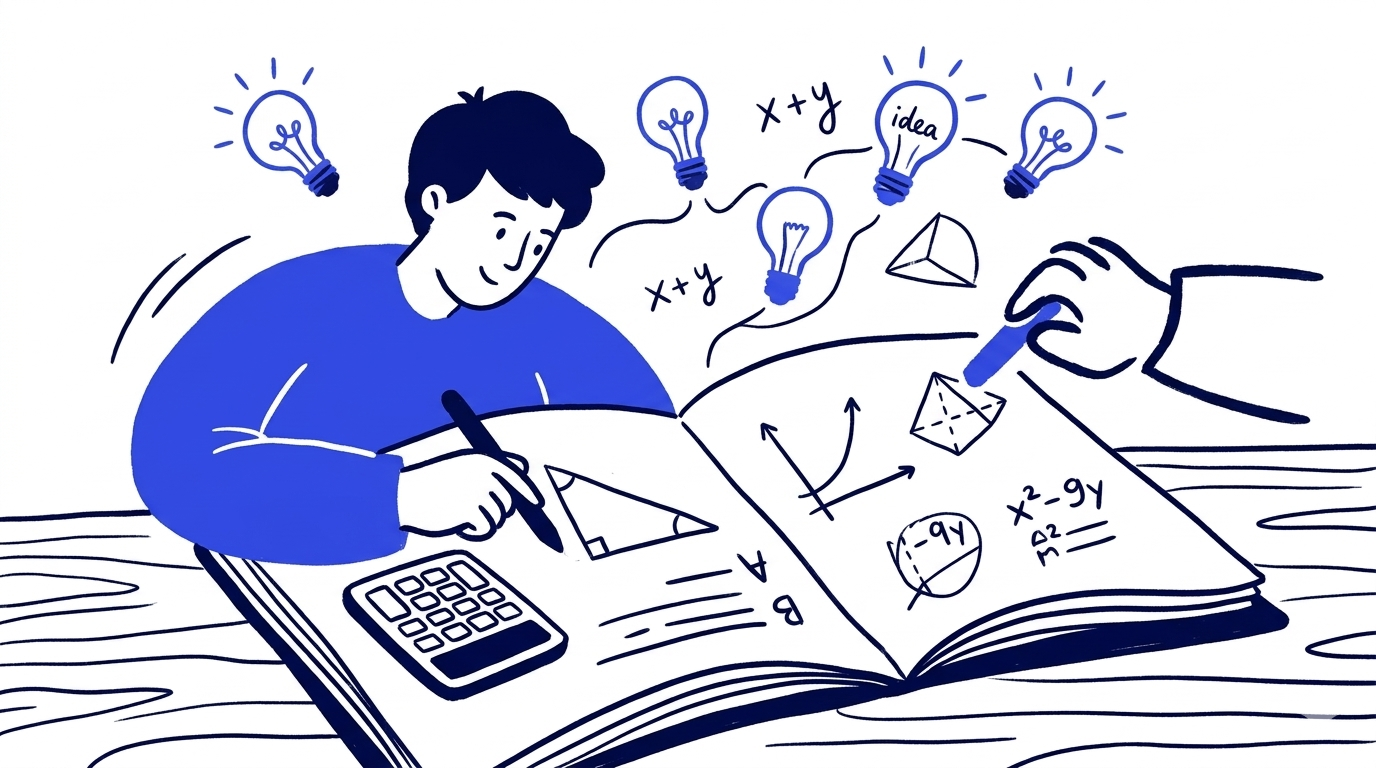
In most cases, the problem has nothing to do with motivation or how much students revise; it is how they revise. Passive revision creates an illusion of knowledge and a false feeling of confidence; active revision, by contrast, builds true understanding. That is what leads to results.
Before identifying the shortcomings of passive revision, it is important to consider the nature of mathematics as a subject. Maths is often mistaken as being centred around memorisation, and while memorisation is involved, the core of maths is actually based in conceptual understanding and problem-solving. Yes, students have to know formulae such as Speed = Distance/Time. Yes, they need to remember how to calculate a mean average. However, more importantly, students must be able to apply these rules in unknown contexts that an exam question might present them with. To master this requires active practice.
Let’s take a question for example:
A train travels at 60 km/h for the first 50km of its journey and at 40 km/h for the second 50km. What is the average speed over the whole journey?
It’s not 50km/h…
Students will know that Speed = Distance / Time, as well as the formula to calculate an average.
However, this question requires problem-solving beyond routine solution. Too often, students drill procedures in the hope that understanding will follow. In reality, it is the understanding of the concepts underpinning those procedures that allows students to adapt when a question changes form.
In theory, revision should develop this understanding, to prepare students for this kind of question. Yet, in practice, many students fall into the same common traps. These include re-reading textbooks, highlighting notes, memorising formulae, copying worked solutions, checking the mark scheme too early, and avoiding harder topics. These flawed approaches share one thing in common: they are passive.
Passive revision builds confidence without competence. It fosters recognition, but not so much recall, and certainly not implementation. Exams are not recognition tasks. They test students’ ability to think critically, select relevant information, apply methods, and demonstrate their reasoning. Crucially, maths exams reward process, not just answers. In June 2024 Edexcel International A-Level Pure Paper 1, 55/75 total marks - 73% of total marks available - were dependent on having correct method. This where the focus of revision must be.
If passive revision clearly does not suffice, why do students continue to use these inefficient methods?
Several reasons - firstly, because they feel productive. By skim-reading and not engaging thoroughly with any one topic at a time, students can cover significant ground in little time. Has anything really sunk in, though?… Secondly, because these methods are comfortable. They don’t require the same effort that active revision does. And finally, because recognition is easily mistaken for understanding. Reading a line of working that they recognise gives students a false sense of confidence, thinking they understand it, but chances are they couldn’t reproduce it themselves in an exam. Just because passive review gets the label of ‘revision’ does not make it effective.
Effective revision must be active. Active revision refers to any approach where students actively recall, apply and explain information, engaging with the activity at hand, rather than passively reading. It is deliberate, effortful and even uncomfortable. Active revision methods most relevant to maths include completing practice questions, past exam papers, and teaching content aloud peers or family.
Practice questions target topics in isolation, from basic, simple-step questions to more difficult, layered problems. These reinforce knowledge in specific topic areas and allow students to identify and learn from errors. Completing past exam papers is particularly powerful closer to exams, as it tests a range of topics at once, while also building exam technique and time management. Verbalisation and teaching content aloud to others ensures thorough understanding of a topic, and whoever is listening can probe by asking follow-up questions about certain aspects, exposing potential weak areas.
Active practice works better than passive ‘revision’, because it aligns with how the brain learns best. First of all, greater engagement in tasks boosts cognitive function, which strengthens neural pathways and encodes memory more strongly. Active recall also forces the brain out of the comfort zone, working instead at ‘desirable difficulty’, an optimal learning zone with strong memory encoding. Last, active revision combats the trap of gaining false familiarity, a frequent outcome of passive review.
With AI becoming increasingly prevalent in young people’s lives, schools must address how they can best leverage technology to aid learning and promote active revision. Tools like ChatGPT offer shortcuts that often pull students away from honest and effective learning - more specifically, they encourage a very passive approach to revision. But these resources are not going anywhere; it now becomes the responsibility of educational platforms to harness technology in a productive way, that promotes active engagement. When used well, technology can enhance revision by supporting an active and effective learning cycle: practice, feedback, reflection, correction.
After all, exams are hard; we don’t need to make them any harder by working inefficiently. Maths is a subject that requires understanding and practice. Reading notes will never be enough. The future of education lies in systems that use thoughtfully designed technology to drive active revision. Active revision turns effort into progress - progress gets results.



