
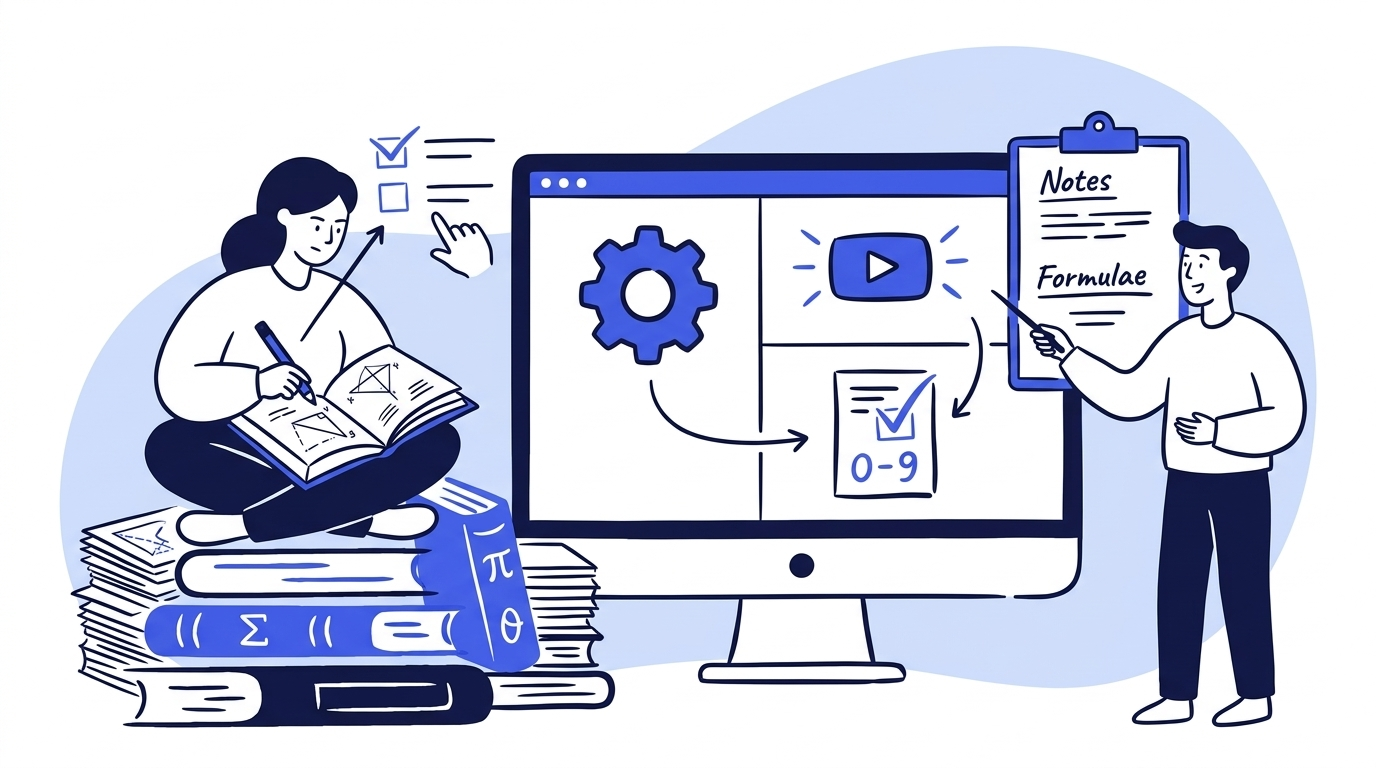
To reiterate, there is no resource that will magically make your revision easy or turn you into a maths machine overnight. It’s an unfortunate truth that learning and revision is often a messy process that is rarely linear, and relies on you being able to make the most of all of the different types of resources available to you. This means that it’s far more important to know how to use resources effectively than working out which particular resources to use.
I mention this for two reasons. The first is to acknowledge that searching for the ‘perfect’ resource is often a form of procrastination. Take a moment to consider this and think about whether this could apply to you. Do you actually already know what and how you should be revising? If this is true, feel free to stay, but I’d recommend getting back to work.
The second reason is to explain why this guide will focus on how you should be using each of the types of resource listed, and give a sense of how you they should fit into your broader revision strategy. This is more important than pointing you in the direction of particular resources.
Having said this, there are a couple of things that you should check for each study resource. The most important is that they are specific to the exam that you are going to sit. This is quite simply because the more you practice the specific questions that you will see in your exam, the better you will perform.
This means that its crucial that you find out exactly which exam you are sitting, if you don’t already know. The two main boards for IGCSE maths are Cambridge International Education (CIE) and Pearson Edexcel, and as such this guide will cover resources for these exams.
Click here to find your specification.
Now you know which board and exam paper you will be sitting, you can start to appraise which resources you are going to work from. As we see it, there are three main types of resource that are absolutely necessary to your revision process. These are:
This is because each of these resources covers a specific piece of your overall revision process, and are indispensable from each other. I.e. You couldn’t revise for your exam by just using one of these types of resources – your revision would likely be inefficient and ineffective.
As such the remainder of this guide will be split into three sections detailing how you should use these resources, and our top recommendations for each category and exam board.
Past Papers are perhaps the single most important resource tool at your disposal. They serve two important functions. First, they work as a diagnostic tool. In other words, they allow you to see what topics you already know and what topics you need to work on. Second, they help you to practice for the day of the exam by working through the same types of questions that you will face. There is nothing that will boost your confidence more then seeing progress in your past paper marks
There are two main resources for finding past papers:
Both are extremely comprehensive resources which allow you to filter through past papers by specification and year. There are certainly other websites, but these two are unbeatable in their breadth. Alternatively, you can go to your exam board’s website and look for past papers and specimen papers there. Often they might only have the last few years rather than an archive of the last twenty.
Questions by topic are essential to practice the areas that you have identified as needing work by going through past papers. Use these to refine and sharpen your skills, so that when you return to a past paper, the problem area is no longer a problem. These questions should also be in the style for past papers and are often more helpful when they are graduated by difficulty. This means you can start with the easiest and see if you can get through to the hardest.
Again, best places to find questions by topic are:
These are essential tools to use when you identify that you don’t understand a topic fully. These resources are a way to learn concepts that you just didn’t get the first time you went through them in class, or have forgotten. However, make sure not to go through these resources chronologically or in their entirety. This is not an efficient use of your time, as you will be repeating content that you already know.
Its good to be able to draw on different types of learning resources, so that you can have the concepts explained to you in a variety of ways. For example, it’s nice to to have a combination of notes, videos and input from real people. As such, learning resources are split into further categories.
Aside from this, its good to have learning resources that are aimed at your syllabus. This means that topics are explained to the level required by your exam, and do not go further. However, if you find a learning resource that makes sense to you that isn’t syllabus specific, don’t worry too much since maths is maths and the underlying concepts are the same.
Video explainers
Videos are fantastic for re-learning and patching up gaps in understanding because they mimic the kind of teaching that you get in a classroom setting. This is probably your number one learning resource if you don’t understand something.
Here are our top recommendations:
Notes
There are lots of places you can find maths notes online for your IGCSE. These are best used if you are looking for a quick refresher on a topic that you have a decent grasp on.
Out top recommendations
Tutors
Finding a personal tutor is one of the most powerful tools to boost your exam performance. A good personal tutor will be able to explain even the most complex topics to you, while also identifying the strategies that will maximise your exam performance on the day. Having said this, it’s important to find a tutor that suits you, and this isn’t always easy.
— link to Article on finding good teacher.
AI resources
AI is fast becoming a staple in every learner and educator’s toolkit. We think that AI tools have the power to supercharge your learning, but only when used correctly. They are particularly good at speeding up the revision process by helping you to mark questions you’ve completed, as well as explaining concepts that you don’t understand.
Our top recommendations for maths AI tools:
[H3] An IGCSE maths revision tool to rule them all?
Having explained the different types of revision resources that you will need to prepare for your IGCSE maths exam, you may find yourself wondering why there isn’t a more streamlined way to guarantee your maths progress. We thought the same. Recognising that the revision process encompasses a range of different facets, we realised that the technology now exists to ensure that everyone can have access to the best quality revision resources. This is why we created Materact, an IGCSE maths revision tool that encompasses all parts of your revision journey.



