
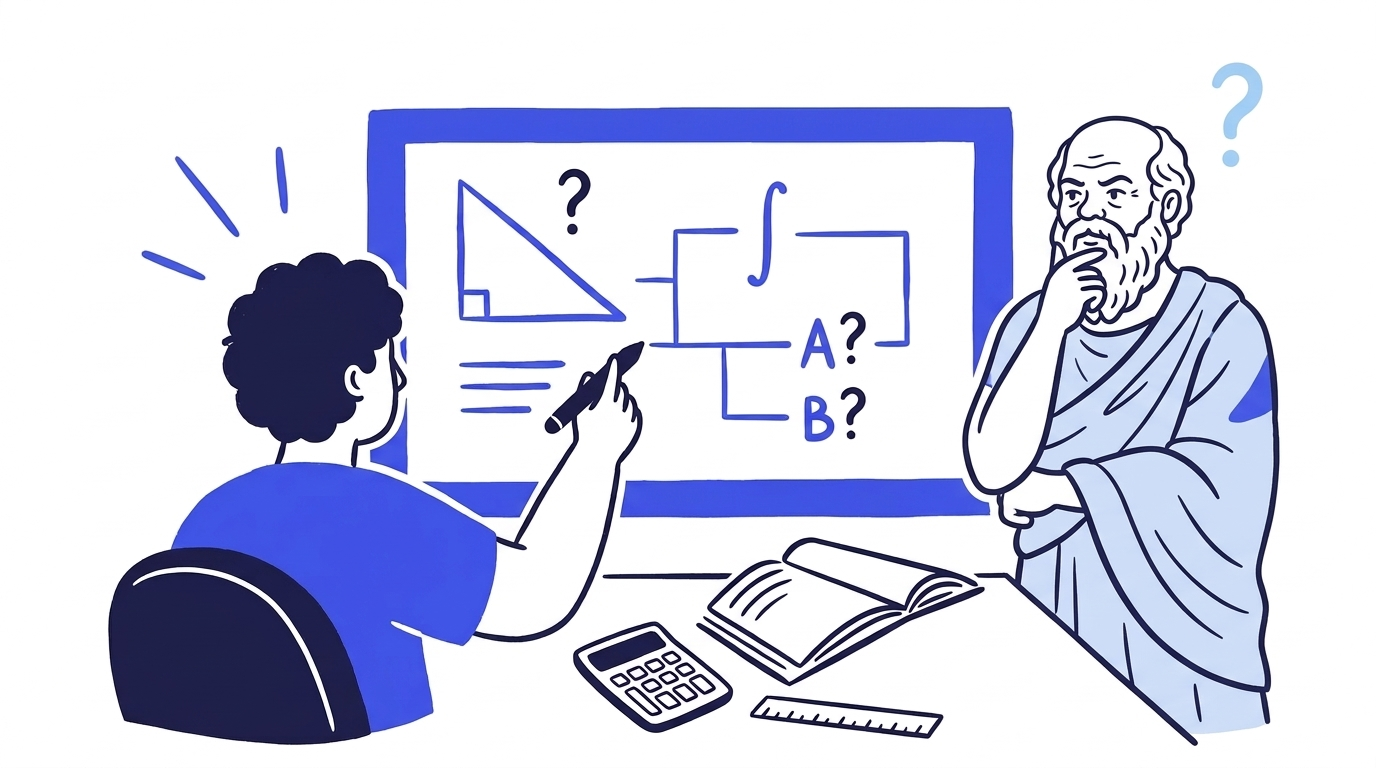
Socrates spoke with many citizens of Athens, asking them extensively about their beliefs and morals. Eventually, he discovered that the people he spoke to could never admit that they do not truly know what they claim. The meticulous, inquisitive approach that Socrates used - deliberate and persistent questioning - is now known as the Socratic Method.
Socrates was sentenced to death several years later, but his namesake method lives on as one of the most widely used educational strategies today. Of particular interest to us in mathematics is the so-called ‘modern’ Socratic Method, whereby a series of logically ordered questions help students to reach answers on their own. This strategy has proven to build authentic conceptual understanding and adaptable problem-solving skills. It enables students to tackle unfamiliar problems themselves, using only their prior knowledge. The example below demonstrates the method step-by-step, where a young student is learning how to calculate the area of a triangle.
What you may notice is that in every line, the teacher asks the student a question. The student reaches the answer, the teacher just guides them.
But why is this question-led approach so effective for learning? For this there are three main reasons.
Firstly, the Socratic method requires active engagement. Rather than passively receiving information, students must constantly think, reason, and make logical decisions themselves. This active involvement boosts attention levels and activates more areas of the brain, including those responsible for memory and error detection. As a result, instead of just storing isolated facts, students build meaningful connections between ideas. In the example above, the student does not simply memorise a formula. They link the new concept - the area of a triangle - to something they already understand - the area of a rectangle. This process creates stronger and more flexible understanding.
Rather than passively receiving information, students must constantly think, reason, and make logical decisions themselves.
Secondly, the Socratic method demands active recall, which creates what psychologists call ‘desirable difficulty’. Instead of the teacher providing an immediate answer, the student must actively work to retrieve prior knowledge (such as the area of a rectangle) and apply it in a new situation. This slight struggle is key: research shows that the moment the brain begins to work to recall information, it encodes memory much more strongly. Learning that feels effortless often fades, whereas learning that requires effort is far more likely to stick. The Socratic method keeps students in this optimal learning zone, where they are challenged but not overwhelmed. And, beyond anything else, this slight difficulty makes learning all the more rewarding.
Lastly, the method develops metacognition, or awareness of one’s own thinking. The careful, question-based approach encourages students to reflect: why a certain step works, whether an answer makes sense, and how different concepts connect. Rather than blindly following methods, they understand the reasoning behind them and build intellectual independence. Students begin to monitor their own understanding, enabling them, further down the line, to catch mistakes earlier and adjust their strategies when they encounter unfamiliar problems.
The careful, question-based approach encourages students to reflect: why a certain step works, whether an answer makes sense, and how different concepts connect.
Given the premise of Socrates’s own philosophy, it would be unreasonable to claim the Socratic Method as the outright best. That said, it remains highly effective in education, particularly mathematics. From the original, ‘classic’ Socratic method that has the aim of challenging beliefs, the more targeted, constructive, ‘modern’ Socratic method that has since developed is put to use by maths teachers across the world. What began as philosophical discussion in Ancient Greece has endured in practice and now aligns closely with what psychology tells us about how the brain learns best: through engagement, effort and reflection.
We do not claim to have all the answers, but we want to ask the right questions. When it comes to sitting official exams, nobody will immediately have all the answers either. But those who succeed are the ones who, instead of treating unfamiliarity as a dead end, ask themselves questions so as to work their way through the problem. And they just might surprise themselves by what they can solve. Socrates would be proud.



